Tuesday, June 30, 2015

Big Y Cluster Bomb and Thoughts about Migration

It's kind of hard to believe it's been a few years since I posted on the 458.2 break up of the Cumberland cluster in the R-Z18 project. I figured it's time to go forward a bit. Look at new members on each side of that divide and think about our Big Y results so far.

Data is coming in fast

Big Y data is coming in very fast now, with loads of new SNPs to map. A process that used to take years is happening in a few months and the volunteer admins of our Y DNA groups are being presented with new information all the time. Joining a Y haplogroup project is one easy way to stay informed and learn more about your group and what next steps you may want to take.

A Cumberland cluster (DF95) person is lucky to fall under several projects. In order of inheritance down the family tree:

All the groups are FTDNA groups but they also have their own separate websites or forums that you can get to from their groups page.

The Timeline

The U106 group has been putting together different age ranges for the SNPs below U106 based on Big Y data and a lot of math that I don't completely understand. I know that it's complicated and that there are several methods and also that it's very hard to know things for certain so everything is done at "confidence levels". 

So a huge caveat, as this new post proves, nothing is set in stone and I didn't do any of the work to get these age estimates.

So let's begin with U106.

Here is a google map pinpoint for the oldest U106 positive male (labeled Rise98) found in Lilla Beddinge Sweden. Listed as being from the Battle Axe culture and aged between 2275 and 2032 BC. It was interesting to find a U106 sample in southern Sweden, but I think everyone in U106 circles was just happy to find one in Europe. So far U106 samples in ancient DNA have been hard to come by and age ranges are all estimated.


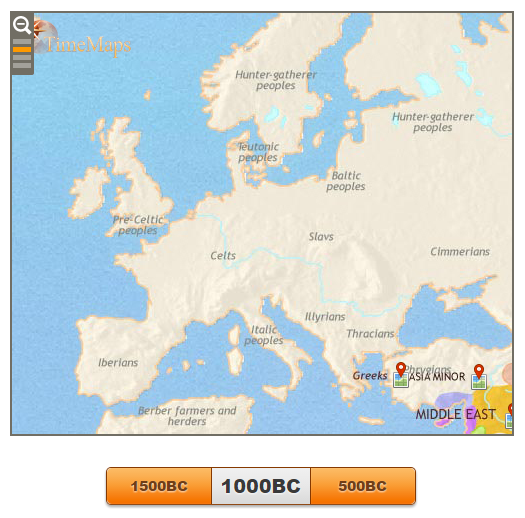
It would be somewhere in this time period that Z18 also appeared on the scene. Here are a couple of nice maps of Europe between 2500BC and 1500BC from timemaps.com:


In 2013 I was looking at a world map for Z18 that started around 1000BC. Today I'm looking closer to 2200BC. That puts the origin point in time for Z18 not very far from the origin of it's parent U106 (estimated at about 2400BC). So the two maps above pretty much cover that ground.

I'm going to diverge a bit further from the comparisons I made in 2013.

Then I did a pretty broad comparison for the different groups with some migration patterns that seemed to fit them. With time, come new results.

For instance, when I looked at the East Anglia Cluster in 2013 it was easy to see the movements of the Anglo Saxons. It probably doesn't negate that movement but they have widened their scope to include someone from Sweden and Poland in their ranks, making their range similar to the Cumberland cluster.

When looking at the current age ranges from Big Y tests for the different SNPs that define the East Anglia Cluster, Polish Cluster (which contains two men from Switzerland) and the Cumberland Cluster, they all appear to crop up at about the same time right around 1300BC and then branch out from there.

The other striking thing (to me anyway) from the Big Y testing was that, so far, these clusters seem to branch right off the root Z18. Time and testing may change that but so far, these clusters seem to be in their own silos, independent of one another for a long long time. I had wondered if we would see some hidden ties to each other through big Y but that does not seem to be the case. Meanwhile, our much older brother Z372 and it's child L257 have lots of branching and layering.

Each cluster has grown and added new locations and variations, their home ranges definitely overlapped at different points (especially in Poland it seems like), but they also seem somewhat more like lonely little islands of Y DNA that sat in a cold sea for about a thousand years waiting to break out.

Here is a map of 1500 to 1000BC along with a description from Wikipedia of what was going on in about 1300BC:


c. 1300 BC, the Indo-European cultures of Central Europe (among them Celts, Italics and certainly Illyrians) change the cultural phase conforming to the expansionist Urnfield culture, starting a quick expansion that brings them to occupy most of the Balkans, Asia Minor, where they destroy the Hittite Empire(conquering the secret of iron smelting), NE Italy, parts of France, Belgium, the Nederlands, NE Spain and SW England. (taken from the Bronze Age at Wikipedia)

Given that U106 was already in Sweden (at least visiting) a thousand years before this, I'm going to suppose that our Z18 clusters were hanging out with the "Teutonic Peoples" there, living the high life of the Nordic Bronze age. That's a guess though. 

Meet the Cumberlands

Here is a pinpoint map of the Cumberlands that are 458.2 negative. They're expected to be the slightly older group as one of their men originated the 458.2 and all the 458.2 plus men inherit that from him. You'll see that I highlighted one there in Norway. That is a new testers since 2013. My old map skirted Denmark and only included the Netherlands and Germany on the continent. 


This is that same map with the 458.2 positive men layered in blue. Never mind the different shapes for a moment, just notice that their ranges are not that different now that we have more testers. The 458.2 negative men still haven't broken into Denmark or Poland, but that could be a matter of time. As always, I notice that the child covers more ground and is more prolific than the parent.


Now we can look at the shapes. For the moment there is only one 458.2 negative person who has tested Big Y and they haven't shared their results. So we only have the information from the 458.2 positive men to work with. 

Both 458.2 positive and negative are typified by DF95 and CTS12023, but no one is certain exactly where they part ways. 

In that map the stars, diamonds and squares represent big Y tested Cumberland Cluster families. In Big Y testing all the 458.2 men shared 14 or 15 SNPs with each other, not shared by anyone else. Without any variation it's hard to tell which came before what. The age estimate was based on a single SNP from that group of 15 and it was dated at about 1242 BC (not too far from the origin time of some of the other clusters). Also, the other Z18 big Y groups seemed to have long runs of common SNPs like this. To me that suggests either a bias in testing (not enough testers yet) or a pinch point where all of us are fairly recently (in the big picture of humanity) related to one man..whose buddies may have petered out.


The Blue Stars

In the second map the blue star in Norway and in Ireland represent two men who leave the rest of the crowd right there at those 15 shared SNPs and go their own way. This split in the Cumberland Big Y is (for the moment) marking the oldest Cumberland Ys. Now we have a point in time and a couple of locations for a beginning. Although the estimate for the SNP was in the 1200s BC, the estimate for the date of a last common ancestor for everyone is much closer in time at about 250 BC. 

The Blue Squares and Diamonds

I'm lumping these two together because the blue squares and blue diamonds continue together for another 4 or 5 SNPs. The one picked for aging is estimated at 58 AD while the most recent common ancestor is possibly as close as 380 AD. Beyond this, the blue squares and blue diamonds go off to form their own groups with their own SNPs and layers.

What is interesting here is that (as luck would have it) we had at least two people from each group (squares and diamonds). Unlike the split for the blue stars where they just part ways, these two groups continue for several more SNPs each. 

For the time being one group is hanging around the U.K. while the other is split between the Netherlands and Poland.  That second group (the diamonds) is very interesting because so many of the Z18 clusters contain Polish recruits.  In our cluster the Polish recruit splits off later (closer to us in time) than the recruit from Norway or Ireland. 

You can see the tale I'm spinning here is similar to the one from 2013. I'm still thinking of a nice central jumping off point for all these people..maybe in that "teutonic peoples" zone. The Scandinavians are great movers of people and I'm still thinking we hitched a ride with them to the Netherlands and Poland and England.

It will be hard to wait for more big Y testing from other groups. Do the Swiss in the Polish cluster form their own group away from their Polish cousin? Is the Polish tester in the East Anglia group older than the others or younger? How about their tester from Sweden? What do the other Cumberland cluster Polish testers look like? How about the 458.2 negative tester from Norway? How does he stack up to the 458.2 positive Norway tester? Where does the 458.2 guy from Denmark fit in?

Big Y has the power to answer so many questions...for a price. Looking at all the new information coming in, I'm sure a revision for this one will be necessary in a matter of months rather than years. 


Sunday, June 28, 2015

Adventures in Big Y and YSEQ

Today I sent my kit back to YSEQ.

I first dipped a toe in the water at YSEQ when I used their "Wish a SNP" feature for my Elmer friends. For one dollar, you can wish for a testable SNP and they will examine it and order the primers for it.

Very nice when you're digging into "family" level SNPs that are of little interest to the larger companies.

Why YSEQ and Big Y

The simple economic truth is that not everyone can afford FTDNA big Y or FGC Y Elite test to be able to identify new SNPs. So, we're attempting to get key players to run the bigger more expensive tests that "blaze the trail" and discover new SNPs that might be valid for the family, with follow up "budget friendly" tests for others through companies like YSEQ.

In the long run we hope to build a panel of SNPs for any Y tester that wanted to figure out which branch of the "Edward Elmer" family they fall on. Also we'll end up with a basic list of SNPs that belong to Edward. They will be the SNPs shared by all the Y testers. Those could be added to a panel of SNPs to take back to England.

What We Expect

Here is a quick chart that shows the Y lines and what we expect to find based on current STR testing. This is where we think everyone will be positioned in the tree when all is said and done. Please forgive my ms word charts. Click them for the enlarged view.


Sons of Samuel

We're currently waiting on the the big Y test from "R1" to add a "Known Tree" counterpart to "L2". These two tests form known pillars. We're missing the middle known tree pillar from "G1" at this point, but we intend to pursue it in the future.  

Brick wall testers L1 and M1 are expected to be related to R1. Likely through Samuel Elmer's son Deacon John Elmer. 

Brick wall M1 was our first big Y tester and blazed the trail for most of the SNPs we have today. He currently has four testable SNPs all to himself. We call them singletons because only one person has them at this time. 

We think we will find that R1 and M1 share some of M1's "singleton" SNPs. Making them private to that branch of the Elmer family. Depending on how many they share, we may be able to guess at a most recent common ancestor. L1 then plans to follow up with YSEQ testing of R1 and M1's shared private SNPs along with their singletons to discover which tester they are most closely related to.  

Sons of Edward 2.

L2 was our second big Y tester. He matched M1 on four testable SNPs that for the time being only belong to the Elmer family.  He currently has one testable SNP to himself. I'm Mike Thompson in that chart. I expect to be related to L2 through Hezekiah Elmer. 

I tested for one SNP that was shared by the Knowlton family (A2277), four SNPs shared by our two Elmer testers (M1 and L2) so far (A2278, A2280, A2283, A2284) and the one singleton SNP of L2 (A5920).

This can all get kind of confusing when we've got all these numbers and letters floating around.

How About Another Picture

Visualizing this tree another based on SNPs. I added some little circles of color to represent SNPs. We're assuming that Sam, John and Ed2 are pretty much like their dad, and get a yellow ball. Because of that, everyone gets a yellow ball. We all get those from Ed1. What I'm hoping for is that somewhere in there either Ed2 or Hezekiah added another SNP..the red ball. Then L2 and I will carry the red ball. It will be private to us and mark our branch of the family.


Along the same lines we're following the sons of Samuel. Our thought is that they may branch off at his son John, but we're not sure. I've added a purple ball in common for them. Some descendants of Samuel also have an orange ball, but not all of them. In that way, we can differentiate the branches coming from Samuel.

Of course, I'll be excited to learn anything I can, but my expectation is that I will share at a minimum the one SNP shared by the Knowltons and the four SNPs the other Elmer testers have. That is the yellow ball in the picture above. Everyone gets it.

My bet is that I will share that single singleton from tester L2, (the red ball) but the odds are not in my favor with only one singleton to test. To put it in context, M1 has four good chances to match R1 and define that they are on the same branch of the family tree. I have only one chance.

The Knowlton Family, Unknowns and the Importance of Pillars

You may have noticed that I tested an SNP shared by the Knowlton family.

The Knowltons have joined us in Big Y testing. They actually share two SNPs with the Elmers, but I could only make one testable at YSEQ. They are also included in the yellow ball in my previous chart in that their SNP was carried by Edward Elmer 1. That's the idea anyway.

The Knowltons are the closest Y relatives of the Elmers at 67 markers. The big Y test one of them completed shows that they are close relatives to the Elmers but we're not certain exactly how close. So our YSEQ and Big Y testing should help put their matches in context as well.

We've got two Elmers Big Y tested. How can one more test put the Knowltons in context and why would there be any question about it?

Well, Big Y tests the area of the Y chromosome that FTDNA thinks will have the most chance of success. So they will  get a lot of great SNPs, but not all of them that exist. The Knowltons may share many more than two SNPs with the Elmers, but we will not know it.

Because we don't know the relationship of  Big Y M1 and future big Y R1 based on a family tree, we can't be completely sure that they are the most closely related. Even though they have all the same STRs in common. STRs suggest a relationship, but SNPs are the mark of it.

M1 and L2 share the most SNPs in common at this point in time. The others (including me) just aren't tested yet and with unknowns there can be lots of surprises.

So our Big Y and YSEQ SNPs may show us a completely different path than we expect.

Expecting the Unexpected

Here is an "unexpected" SNP based tree that could include the Knowlton family. If it were to turn out that M1 and L2 were more closely related than expected then the tree could play out more like this, with the Knowltons included because the new base "yellow" ball is really the two SNPs they share.


The reference docs are pretty blurry in the 1600s and NPEs happen. It's possible that John Knowlton (who all the Y STR matched Knowltons go back to) was really an Elmer adopted by the Knowlton family. The two SNPs shared with the Knowltons may just be the Edward Elmer SNPs we're looking for.

The key thing is that without testing R1 or G1 and comparing them to L2, we don't know what the structure of the tree is.  R1 and L2 as "pillars" of our structure will help define what those early 1600s SNPs were and in doing so, help place everyone involved.

Notes About the The Testing Process

So far, FTDNA's Big Y has been pretty darn easy. Most of these men already had kits from Y STR and earlier SNP testing, so ordering an upgrade was really a matter of saving the money and waiting for a sale. Like falling off a log really. They identified an issue with M1's stored sample early on and sent him a new kit in no time. The results also came back quicker than expected.

We have relied heavily on the volunteer admins at the U106 group and the Z18 group to analyze the results and give us some direction because FTDNA's Big Y results matching has some issues.

I took those SNPs that FTDNA provided and our Y groups analyzed from M1 and L2 kits and added them to YSEQ through the Wish a SNP process. YSEQ has been fast and responsive. They assigned me a user account much like FTDNA did. Their website is not as polished but..really it's the results and flexibility I'm after.

Their swab kit for my SNP test order came in the mail within a week of the purchase. Mailing it back was a minor adventure because I've never mailed a package to Germany. Less than the cost of a lunch at McDonald's later, my kit is on it's way. I have read on forums that they are lightening quick on turn around for these kits, so I'm very hopeful I'll have my results fairly soon.

Monday, June 22, 2015

Fathers Day Y mile markers

What you can see from the Ed Elmer blog I threw together is that we've been doing a bunch of Y work between the Elmers and Knowltons. This weekend..ironically or not Father's day weekend, we launched two more Y probes to add to the results from earlier tests this year.

For the Elmers we have one big Y test that will give direction to the group. We had one test down the line of Edward Elmer 2 and one test from an Elmer whose tree is stuck around the time of the revolution. This new test is down the line of Samuel Elmer. With two known lines from Edward Elmer 1 through sons Edward 2 and Samuel, we should be able to get a nice list of those SNPs that belong to Ed 1 and which continue down individual lines. Triangulating the Y.

It will also help place the Knowltons in the scope of the Y family. The Knowltons share two SNPs that no other tester has shared yet. Depending on how this test shakes out, it could help place them as relatives on this side of the pond or back in England.

It is a very big deal for this small group of men who have come a long, long way.

I hit my own milestone this weekend too.  Along the way, I've made the Elmer related SNPs testable at YSEQ. I ordered my own test there, specifically looking to match up with my Elmer counterpart who is related to Hezekiah Elmer in 1680. That's the line I expect to be down given the research I've been able to do.

 I won't get a list of my own SNPs to track like the Elmer men did, but I haven't been able to find an Elmore man farther down my expected line to test anyway. I could also run the other next gen tests at some point in the future. I'm just impatient to know if I'm on the right path and if the signs are pointing in the right direction and I'd like to have my results when we're discussing the results of the group.

I hope to get some definitive answers to a lot of questions in the next few months. Some very personal and some on a grander scale. I'm also looking forward to taking what I've learned and applying it to the U152 Thompsons.

On father's day, thinking of things I'd like to continue to do with Y DNA:


  • upgrade the U152 Thompson kit to 37 or 67. I think I will tackle this next.
  • get our Jensen Z18 tester from Denmark tested for some of these new SNPs if not big Y itself. 
  • create a panel at YSEQ that we could use for Elmer/Elmore men in England to try to recruit overseas. 
  • find that elusive Elmore man related to James Walsworth Elmore who is interested in getting a Y test to definitively back up my assertion that James is related to Edward Elmer 1.


Saturday, April 4, 2015

Autosomal DNA A tale of two stacks of pancakes

Basically, I like pancakes. So I think about autosomal matches and their segments like stacks of pancakes. Everyone gets two kinds of pancakes. One from your mom and one from your dad. Even if you don't know which one is which, you can actually start sorting them into those two sides.

I'm using 23 and me here because it has the most straight forward chromosome matching system I've found outside of Gedmatch.com.

So here's an example of a bunch of overlapping segments from genetic matches. This is from my dad's perspective. See chromosome 1 there with 4 little pancakes stacked up. He matches Thomas, Jeremy, Paula and Jenette in roughly the same area. Some pancakes are bigger and some smaller, but they roughly stack up.


That is a mixed stack of pancakes. We'll call them blueberry and strawberry. We don't know which are pancakes from mom's side and which are from dad's side or if all of them are from the same side.

For now we'll consider that they might be blueberry and strawberry pancakes mixed together.


The goal is to sort them into two matching teams. We want to know all the strawberries and all the blueberries and only compare them to each other.

Why? Well, we're figuring out which side of the family to focus on. When you're looking at family trees if you can narrow the results in any way, you can cut thousands of possible relatives out of the search, just by splitting your matches into sides.


From my dad's perspective we would have to search each family tree for each of four people for all the ancestors of each person back six or more generations. From my dad's perspective they could all be related to the same person. But what if they're not? Everyone matches my dad, but do they all match each other and therefore all share the same ancestor?

The way you find that out is by sorting them based on how they match each other. In genetic genealogy you need to see the world through someone else's eyes. I need to know which pancakes are blueberry and which are strawberry..if any.

So one way or another, I need to become one of the other matches for a moment and see how they see this same stack of pancakes. 23 and me and Gedmatch make that easy..you can just check people against each other to see how they line up. FTDNA comes close with chromosome browser and the matrix...Ancestry folks are on their own (they can't do any of this).

Begin sorting.

Let's become Thomas then. How does Thomas see this same stack of pancakes. The trick is, Thomas will only see his matches. He is either a blueberry or a strawberry pancake and he will only see his kind of pancakes in the stack.


Aha! There he is. Thomas matches Thompson of course..we knew that, but Thomas also matches Paula in the same spot. We can arbitrarily label them as strawberry pancakes. Of this stack of pancakes they only match each other and my dad.


Next step. Pick one of those 0 people who were missing. They "should" match each other, but we need to confirm it. Does Jeremy match Jenette?


Goal. Jeremy matches Thompson (as expected) but only sees his own kind of pancake, Jenette. We now have a blueberry stack as well.


Keeping in mind that I have no idea which side of my dad's family they are on..I do know that they are on one side or another. Further, I will only look for common ancestors between Jeremy and Jenette on the one side and Thomas and Paula on the other.

In this way, your segments (pancakes) can validate each other. They form "triangulated groups". People who match you and each other in the same area on a chromosome, thereby sharing a common ancestor among all the matches.

What if you go through this and there are no blueberries and only strawberry pancakes? Well, you'll just have to wait for some blueberries to show up. What if you find a pancake that doesn't match any of the other pancakes, blueberry or strawberry. That is a pancake that is probably an error. Someone who matches you by accident. Typically larger segments (pancakes) are less likely to be one of those accidental matches.

Just like with regular genealogy, genetic genealogy is skeptical. You have to PROVE IT. You can have hunches and that is okay, but it's not enough that two people who are genetically related have the same person in their tree.

You need at least a third person with that same ancestor to match you on the same chromosome, roughly on the same segment (a little bigger or smaller is okay). Just like you need more than two legs in a stool, you need at least three legs in a genetic match. Figuring out which legs belong on which stool is all a sorting game and you can do it before you ever look at a family tree. 

Sunday, March 22, 2015

Y67 Results Getting from point A to Point B

My Y 67 results sauntered in a few days ago. At this point, having crabbed out from my Thompson hunt to effectively engaging in an Elmer hunt, I expect to be close to one of my Elmers and that is the case.


In the FTDNA 67 panel, I'm exactly the same as my Elmer 67 counterpart. The two pink numbers we have in common are DYS520 (21) and DYS572 (12). At the U106 project, the closest big Y test so far to our Elmer tester is also a 21 at DYS520 (Lunsford). There are others that are 21 there as well, like the Knowltons (always close) and Jensen from Denmark.  The 12 at DYS572 is not as common among 67 testers at U106. There is another person with that value at the Z18 project, Ralowicz from Poland, but it's not carried by the Knowltons or Lunsford.

At 67, my match list has one Elmer kit (our only 67 tester) at a distance of 2 and several Knowlton kits at a range of a distance of 6-7. I would say there is a bias in sampling, but there are several other DF95 men at 67 to compare to, so it's not that there are no more kits out there to look at. These two families are just closest to me.

If you look at the 67 match results for our Elmer kit, they have several more Y67 kits in their match list than I do. Some of my mutations away from the other Elmers also limit my matches. My DYS449=29 (which I share with only one Elmer) and DYS576=18 seem to be particularly troubling to other R-DF95 men.

At this point, I've reached the stage where there is little doubt about who I'm related to on my direct male line circa 1610. I've eliminated enough variables to get down to my core Y family. I'm feeling really confident that I've covered my bases. I'm related to Edward Elmer.

He came here, pretty well alone as far as I can tell. He was a Puritan (oye, he would certainly not approve of me) and he was part of "Hooker's Company". People who disagreed a little with the Puritans in Massachusetts and moved on to found Hartford Connecticut.

Getting from point A in 1974 to Point B in 1610 may still hold some surprises. Only further Y testing or autosomal testing of new candidates will help me narrow that gap and solidify my theories..although they seem really solid to me for the time being. Solid enough to include the Elmore family from Peoria as possible links for Family Finder and 23 and me testers.

There is still a margin for error in there in my autosomal results. Although we had a good autosomal match with a member of that Peoria family, I haven't put together all the clues or groundwork to prove it's a match through the Elmores. I think being related to the Elmores is just the most likely scenario..but not the only possible one.

This summer I'll be approaching what I expect to be my final move with my Y chromosome. Big Y testing to compare to my closest Elmer match. I'll be working with the Elmers and Knowltons to try to layer out our SNP results.

There may be some surprises for the group hidden there too. We'll see what we see. That is where the fun is.

That testing and layering should give us a framework and some benchmarks for testing other people and it should bring the costs down. Effectively we can take what we've learned about our SNPs within the Knowlton and Elmer families and devise cheaper SNP tests at YSEQ that would give someone the Y branch of the Elmer family they belong on. If they wanted to go farther they could then take the ball and run with it.

So if I ever do get to the point where I have a willing Elmore tester who may be closer to me on the Y than my current testing buddies, we can find the definitive answer for $17 instead of $500 plus.

I also expect that I'll be able to take all the knowledge I've gained and the tools I've found and use them to get my Thompson family over it's brick wall. I'm actually hoping I'll be able to streamline the process for them.

As ever, the journey continues one step at a time.


Monday, February 2, 2015

Elmore and Elmer Ancestors by Cousinship

Okay. Here there be dragons.

By it's very nature this family tie is...difficult. There is no paper trail to connect to here, only some DNA evidence, rough proximity and timing. This listing constitutes my best guess at the time given Autosomal and Y DNA Evidence. I've been wrong. I'll be wrong again...but I'm tired of trying to describe this family to people so I need a standard cousin listing like my other families.

Another note about the family, some of their lines are shrouded in mystery. Several family trees do not progress beyond James Walsworth Elmore. Ironically, that is where my Y match to the Elmers and Elmores comes into play.

Here is a list of my dad's most likely "Elmore and Elmer" relatives by cousinship:

****2nd cousin sharing great grandparents****
This is going to be tough. There are several men I suspect could be my dad's great grandfather. I have no Y test closer than Hezekiah Elmer born in 1686 to guide me. I do have the convenient proximity of this family in Peoria IL (and surrounding areas) in 1924 and the results of one autosomal test. The match was good on the autosomal test, but at a 3rd cousin range when I was expecting a 2nd cousin. Also the matching segments don't triangulate to any known members of any family yet.

I'm going to list the couples that might foot the bill. As a result there will be way too many people here and lots of notes. Take your pick.

Elbridge Walsworth Elmore 1850 Clinton NY.
Sarah Jane Hargraves 1844 NY
note: I think this couple is unlikely because they move back to New York putting them a bit out of reach.

Herbert Leslie "Darby" Elmore 1870 Peru Clinton NY
Elta Mabel Davidson 1880 Illinois
note: I don't see any children for this couple.

Halsey Orton Elmore 1866 NY
Etta Mae VanHouten 1868 Ill
note: multiple sons. This family was my first choice. A descendant of Halsey is a good autosomal match for my dad, but in the 3rd cousin range. That makes me think it could be one of Halsey's brothers.

James W Elmore 1864 NY
Elmira 1871 Ill
note: no children listed.

Asa Buell Elmore 1857 Clinton NY
Georgetta Craft 1867 PA.
note: the Craft family name appears quite a bit among genetic relatives of my grandfather, but these Crafts go back to Germany while the others do not.

William Ernest Elmore 1854 Clinton NY
Elizabeth Cranford 1860 Ill.
note: There may be a connection through some of Elizabeth's Harrell family to genetic relatives at 23 and me and FTDNA who have Crawford and Harrell families. It would be a very old autosomal match.


****3rd cousin sharing 2nd great grandparents****
Some of these will be missing. Without knowing which guy could be a great grandfather, I'll stick to listing the two people I feel most confident of. This would be the most likely common ancestors for the autosomal tester in the Elmore family.


James Walsworth (or Walworth) Elmore 
Birth: 1823 Essex NY
Death: 1904 Seville, Fulton, IL

Lydia Ann Hicks
1824 NY
1887 Seville, Fulton, IL


****4th cousin sharing 3rd great grandparents****

James Elmore 

birth 1798 Peru, Clinton, NY
death 1833 Peru Clinton NY

Katherine Cochrane
birth 1803 
death 1825 Peru Ny

Amizi Amaziah Hicks
birth 1788 NY
death 1870 Seville, Fulton, IL

Lydia Ann Fuller Irish
birth 1793 Peru, Clinton, NY
death 1869 Seville, Fulton, IL


****5th cousin sharing 4th great grandparents****

John Elmore
birth 1766 Northampton, Hampshire, Massachusetts
death 1840 Peru, Clinton, NY

Elizabeth Hay
birth 1778 Quebec Canada
death 1851 Peru Clinton NY

Here the Hicks, Fuller (or Irish) and Cochrane families have kind of disappeared. I've poked at them a bit but I haven't pushed them any farther.

Elizabeth Hay is the daughter of William Hay from Scotland and his wife Elizabeth Williams who may have been from the U.S. 


John Elmore is the son of Daniel Elmer and Mary Norton from Franklin Mass. Daniel is the son of Hezekiah Elmer and his wife Miriam Standish Janes of Massachusetts. That brings us to our closest Y match.

Friday, January 30, 2015

Segment Comparisons, Perspective and Inheritance

I wanted to post some examples of the differences between close relatives as they relate to more distant relatives and touch on inheritance and the luck of the draw. The reason for showing these is to give some sort of visual display of the ways in which related people match each other in different ways.

My Dad and I


I'll start with the one that I've had the most comments on at 23 and me. When people compare me to my dad they see something like this:


given the small format, you may want to click these to get a closer view. Above is my comparison to my dad. The comments I normally get from people are along the lines of "how can it be that you are exactly like your dad". 

The key is that my dad gave me half of his DNA. He built half of every chromosome I have (except the X). So I'm half identical on every chromosome. What it's easy to forget is that most chromosome browsers show you "half identical" segments...not fully identical. 

When you have a match to another person (unless they are a full sibling) you will normally only have half identical segments in common.

What I'm showing here is that for me, there is the opportunity to have a match to my paternal family on every chromosome, in every position. Even though every chromosome is covered, it's only half my DNA.

My Dad, his Maternal Half Sister and their Maternal Uncle

Okay. Time to add some complexity. Here is the broad overview of my dad, his uncle "R" and his half sister "C". This is from my dad's perspective his half sister only has DNA from their shared mother's family. His maternal uncle is his mother's brother so he has the same family in common. 


I'm going to close in on some of the chromosomes at the top to illustrate some differences. I apologize if you have trouble telling blue from green. I didn't have any choices for colors at 23 and me. My dad's uncle R is in green. Half sister C is in blue.


Things to note when looking at this. Notice that even though R, C and my dad all share the same very close family and all the same ancestors on my dad's maternal side, there are differences in how R and C match my dad. These matches represent DNA coming to my dad from his mother. 

You can see that there are places, like on chromosome 1 where sister C matches my dad but Uncle R does not. That makes sense because uncle R and my grandmother were not twins, they got different DNA from their two parents. 

You can see that there are places where uncle R matches but sister C does not like on chromosome 5 and a good chunk of chromosome 4.  Again here uncle R and my grandmother have the same DNA and my grandmother handed some segments down to my dad, but not his sister. This also makes sense because my dad and his sister are not twins. 

They both got half their mother's DNA, but the halves they got were not identical. The halves were randomly generated from all the DNA available to my grandmother.

Also notice these pictures compared to my match with my dad. Even my dad's uncle combined with his sister is not enough to recreate the DNA my grandmother gave my dad! There are maternal relatives in those white gaps that don't match his sister or his uncle.

From the Sister's Perspective

Now I want to look at these same matches from my dad's sister's perspective. The same three relatives all share the same family. The matches are similar in many ways which makes sense, but they are different in striking ways too. My dad here is in Blue and R again is in green.


Compare and contrast with the close up above. Sister C has a remarkably bigger segment in common with uncle R on chromosome 3. Where my dad has an amazing amount of white space, she is a half identical match to uncle R.

What is important there is what you don't see in my dad's close up. Remember that his mother fills up the entire chromosome for both my dad and C. It's not that he doesn't have relatives of his mother there, it's that they will most likely be different relatives than C and R have in that same spot.

For example. C and R may carry a large segment of DNA from one maternal relative while my dad carries a large segment there from another maternal relative. My grandmother had both to give, my dad got one and my aunt got the other. In really simplistic terms, maybe my dad matches his maternal great grandmother there, while C and R carry DNA from the great grandfather...or something to that effect.

What's the Point of all this?

The point is that even closely related people who share the exact same set of close ancestors and get huge amounts of DNA from those ancestors, do not get the exact same DNA from those ancestors. Uncle R is not definitive for my dad's maternal matches. Neither is sister C. Together they come very close, but still not close enough to cover all the ground. In those cracks are the exact same ancestors shared by everyone in the group, just broken up in a different way.

Somewhere, another cousin may fill the gaps in. Perhaps one of my dad's first cousins through a different aunt or uncle will hold the keys to those white areas. They will have matches to the same families but in different spots on different chromosomes.

Here is my last example image, I promise. This is from the perspective of sister C again. My dad is blue, Uncle R is green and common cousin P is purple. 

P is related to C and my dad's great grandmother Clara Beadle. Clara is uncle R's grandmother. P shares about 206 total cM with sister C, but I'm going to focus on chromosome 22 for a minute because it's a perfect illustration. 

Uncle R in green overlaps my dad a little there in blue. Both do not overlap with P, all are related to Clara Beadle in some way but that doesn't mean they will always match each other where P does because they all got different DNA from the Beadle family. Each of these matches could represent Beadle DNA. P cannot be the definitive check for Beadle DNA because he doesn't cover enough ground. 

Here is what I mean by P can't be definitive for Beadles in my family:

P shares 206cM on 8 segments with sister C.
P shares 156cM on 6 segments with my dad.
P shares 145cM on 10 segments with uncle R.

The Beadle family is about 1/4th of uncle R's DNA and yet P shares the lowest amount of DNA in total with R! My grandmother has more in common with P and handed more of those common segments to her children C and my dad. Uncle R is not less related to his Beadle grandmother than his sister was, he just got different DNA from her!