If you had asked me when I posted Migrations, I would have said we were Celts and that we were probably L21 and possibly M222. Now it seems we are closer to "Frisian" R1b lines and probably S21 and possibly S29. People who look like me fall into many of these groups.
Knowing for sure what our group is will cost me some money. Ancestry.com doesn't offer SNP testing. Sorenson says they may offer it in the future. FTDNA, Ethnoancestry and Genebase would have me start over with them in order to get them.
No matter what, I think it's safe to say that we're part of a group of people that probably lived in and around Germanic peoples and were probably Germanic themselves. The areas people like us inhabit are full of well known Germanic groups, from the Lombards in Italy to the Norse up in Norway. East to the Visigoths and west to the Frisians, Angles and Jutes. My closest Thompson match now is from Holland.
Getting to England...
We may well have entered England right along with the other Celts, lived a Celtic life for hundreds or thousands of years. Some of our family may have ventured off as soldiers of fortune in Germany, France, Sweden, Denmark and Poland as Scots abroad, eventually adopting the names and languages of those cultures while others migrated to the U.S. with our Scots Irish kin.
We may have been Angles or Saxons or Jutes invading after the fall of the Roman empire and becoming part of the fabric of England and Scotland. Replacing the language and social order, and making the Britain into Angla Land. So much so that when our Kindred Vikings began colonizing Britain we considered them the "invaders".
We could in turn be those very same vikings moving from Denmark with other Scandinavians pushing into Germany and east into Russia and west to England and Ireland. Altering the places and names of the people we encountered. Adding words and concepts to their languages that are still used today.
We could be the so-called 1/3 of Normandy that may contain Northmen and moved in with William the Conquerer to stake a claim in England.
We could be descended from Frisian merchants and weavers invited to England and Scotland after heavy flooding in the German Low Countries, helping to create the economies of both countries as a working immigrant class.
The theories abound. My personal feeling... It has to be a feeling at this point because I don't really have any hard evidence...is that we are either the product of the Anglo Saxon or Viking-Danish colonization of the British Isles. Genetically, I seem to have close matches in those places where these people were most active. Denmark seems to be particularly close although not prolific. All of that still leads me to the conclusion that we are most likely Lowland Scots and Borderers or Northern English..culturally there may be little difference. We still most likely came to the U.S. after being a part of the Plantations of Ireland in the 16 and 1700s. That's what my gut tells me. Sometimes, my gut is wrong.
There is another perfectly good explanation for our surname and our DNA. That is that we are a product of German or Scandinavian settlement here in the U.S. around the same time the Scots Irish are making their historic run west. We may indeed be Thomsens who changed their name to Thompson to match those people they were living with and around. Tracing Scandinavian families can be frustrating because they used a patronymic scheme until the 1800s with children taking their fathers name every generation. Our Thompsons could have been Nelsons or Petersons in the 1700s.
Right now, I think some of this conjecture hinges on the Knowltons. They are closest to us in any search I do. They also seem to have some issues with where they come from. They have a place name. A town name, but it could be named for any town on a knoll. They seem to be a small family though, which is ironic since Thompsons are everywhere. It seems from their own postings online that they have a genetic split in their family and openly are questioning their semi-mythical link to Kent England. Tantalizingly they seem to have ties to Nova Scotia (New Scotland) in modern Canada. Also it appears that they may be R1b-S21. The person in charge of their DNA project says that I am not the only one who matches the Knowltons and not many else and that the Knowltons seem to match each other and not many more. He left off saying he wanted to look into my "vitals".
So here I am, stuck in the middle with you.
We will see how this adventure continues.

Sorting out the Puzzle Pieces in My Big Messy Family
Friday, December 17, 2010


Migrations 4 Common Maps and Ideas
As you go through this it may help to reference Migrations 1 - 3 to see the other maps I'm comparing to.
Early on in my search the things I found left me pretty well established in Northern Ireland. I had a couple of family trees that landed there and my DNA seemed to be very close to the Northwest Irish Modal. Everything fit nicely. When you look at the map of R1b the odds are in favor of being from a Celtic nation. I have to admit, that would suit me just fine.
One of the first things I ran into was the OGAP map which mapped out migration paths for OGAP groups. Our OGAP group would be OGAP19.

And that's okay. You can see the path through Southern England into Ireland and over to the Western Isles which makes total sense. It would also explain the odd North South split in my matches in Britain. In some ways it also backs up the MacTavish claim to Thompsons. Except that no Thompsons look like me...but still, for me it worked out. I'm a Celt.
But again there is that nagging feeling that something is amiss. It's not just that I don't see any Thompsons in my matches. I don't see a lot of highland clans in there. I see a lot of Brits and Quite a few Scots both east and west, also I see Scandinavians and Germans, Swiss, Polish and Austrians even a few Baltic Russians. This analysis is running on so few numbers that they're called bikini haplotypes. They just don't cover much and can lead to a lot of assumptions. I'm sure for many people this map and migration route is correct. For me, I fear it isn't.
Here is a more consolidated map of the range of my matches taken from the other maps I've made.
 Now given that this is trying to map ancient people to their relatives today, there is some room for fudging. Also in the scope of this map you're missing the Austrians, Czechs, North Italians, and Polish. Also under-represented are the few Norwegians in the mix. You can't ignore though that there is a large dip in France and that there is a decidedly "Northern" and roughly coastal flavor to my matches. It's not too unlike the OGAP map though.
I recently had someone label me a North Sea Celt, but I can't say that all R1b people are Celts. There wasn't ever a hard line between these peoples that I can see so my Ancestors may have spoken a Celtic language but it also seems really likely that they spoke a Germanic Language. When all the other Celts are lining up behind the Basques, my family seems to be lining up with the Germans.
Because there are so few of us and we are so spread out, it's hard to discern a true pattern, but I'm going to try. As I look at things more and more it becomes a bit more I get the feeling that we're much more Germanic than I, at first, suspected.
Take a look at this graphic. It's from a paper by Campbell that talks about Capelli's groups in the British Isles and gives some stats on where people who looked like that came from. I've only included my match here, but I think it's kind of telling.


Early on in my search the things I found left me pretty well established in Northern Ireland. I had a couple of family trees that landed there and my DNA seemed to be very close to the Northwest Irish Modal. Everything fit nicely. When you look at the map of R1b the odds are in favor of being from a Celtic nation. I have to admit, that would suit me just fine.
One of the first things I ran into was the OGAP map which mapped out migration paths for OGAP groups. Our OGAP group would be OGAP19.

And that's okay. You can see the path through Southern England into Ireland and over to the Western Isles which makes total sense. It would also explain the odd North South split in my matches in Britain. In some ways it also backs up the MacTavish claim to Thompsons. Except that no Thompsons look like me...but still, for me it worked out. I'm a Celt.
But again there is that nagging feeling that something is amiss. It's not just that I don't see any Thompsons in my matches. I don't see a lot of highland clans in there. I see a lot of Brits and Quite a few Scots both east and west, also I see Scandinavians and Germans, Swiss, Polish and Austrians even a few Baltic Russians. This analysis is running on so few numbers that they're called bikini haplotypes. They just don't cover much and can lead to a lot of assumptions. I'm sure for many people this map and migration route is correct. For me, I fear it isn't.
Here is a more consolidated map of the range of my matches taken from the other maps I've made.

I recently had someone label me a North Sea Celt, but I can't say that all R1b people are Celts. There wasn't ever a hard line between these peoples that I can see so my Ancestors may have spoken a Celtic language but it also seems really likely that they spoke a Germanic Language. When all the other Celts are lining up behind the Basques, my family seems to be lining up with the Germans.
Because there are so few of us and we are so spread out, it's hard to discern a true pattern, but I'm going to try. As I look at things more and more it becomes a bit more I get the feeling that we're much more Germanic than I, at first, suspected.
Take a look at this graphic. It's from a paper by Campbell that talks about Capelli's groups in the British Isles and gives some stats on where people who looked like that came from. I've only included my match here, but I think it's kind of telling.

At first is seemed to me that this was a really Celtic set with all the matches in the Western Isles and Llangefni in Wales, but now I look at my maps and some maps of more recent history than these OGAP migrations and I think that maybe people who look like me came in one of the waves of Germanic tribes. Whether it was Vikings from Norway or Denmark or Angles and Saxons or some other Baltic Sea tribe like the Geats. It started to come together when I looked at this map of Viking England on a Children's homework site.

I've found from reading about viking settlements in Britain that Wales was not untouched. Anglesey where Llangefni is (9 matches in the chart above) was also a viking settlement and that Anglesey isn't named for the Angles, but is an old Norse name meaning Ongull's Island. Also, although the map does show a little pink arm riding up into Cumbria, I've read that it was also a viking settlement along the coast.
Here is England while it was under Cnut the viking King of Denmark:

Here is Anglo Saxon England:

On this map from Wikipedia the Britons are the Celts and the other named groups are Angles Saxons and Jutes. Most Thompsons in Britain live right up there in Northumbria about where it says Bernicians. There are many Bernician names that make up my matches.
For more representation on the continent here is a map of the Ingavoenes. The "People of Yngvi". Some think it's where the Angles get their name.

To me, it seems that my matches can always be found where there is a Germanic influence in Britain and Ireland. My matches in northern Ireland are probably not because I match an Irish gene, but because I match a Germanic group along with other lowland Scots and Northern British. Both Scots and Northumbrian English are Germanic languages (as is old English). The closest language to English and Scots today is Frisian.
To add more fuel to the Germanic fire, I was looking at the results for the Knowlton DNA project because they are closest to me in almost any search and they seem to share my 16.2 at DYS458 (sometimes these .2 numbers at DYS 458 are referred to as 458.2) which is pretty rare. It's something like 1% of people at SMGFs Y database.
I noticed that one of their people is S21 positive. Most just show R1b1b2* but one person had more testing and came up with S21 or R1b-U106 or at this time: R1b1b2a1a1*.
At the same time, I ran into this bit from Genebase in their tutorials section:
R1b1b2a1a (S21+), previously known as R1b1b2a
Unusually short DYS458 alleles (DYS458.2) are associated with R1b1b2a1 (S21, aka M405). Cases of this allele have so far been detected in Ireland, England, Germany, the Netherlands and the U.S. (1-5%) and this appears to a unique west European marker. The DYS458.2 allele also occurs independently in the Y-chromosome J1 subclade.
The R1b1b2a1 (S21+) is a prominent R1b subclade and is likely the major subclade in resolving identity after the R1b1b2 (M269+) subclade. It frequency is highest in the Dutch (35%) and it is also rather high in England, Germany, Austria, Denmark, Czech Republic and Switzerland (13-23%). This region overlaps origins of Germanic groups, such as the Anglo-Saxons in Frisia. It does not appear to have extended its reach beyond West and Central Europe (except recent migration to the U.S.).
The levels of the R1b1b2a ( subclade in conjunction with other R subclades have not been reported to date. Check this site regularly for updates on this subclade as new information will be posted as studies become available.
So there are my DYS458.2 numbers that are so rare. I also read somewhere that the J1 subclade is 19.2 and above where the R1b U106 seem to be 18.2 or less. (I don't remember where I saw it so it should be verified. The entire article from the study can be seen at the U106 DNA project site or directly here.
R1b S21/U106/M405 makes up about 25% of Europe, if we're S21 then why then do I have such a hard time matching people? Well, we're not exactly the "norm" for S21. We don't fit the modal there much better than anywhere else. It just seems right, right now.
All of this is conjecture without actual SNP testing, but it could inform the kinds of tests I try when I do look. For all I know we really are the Irish Modal and this has been a complete waste of time. This idea seems to fit right now though with all the odd locations and the broad match set. With this in hand, when I have some money to burn, I'll order some kind of testing that will give me SNPs to work with. Then we'll have a much better idea of where we fit.
Next up, I'll go over the broad theories I have about all this and how it could effect my search.
Sunday, November 28, 2010
Migrations 3 - Other Databases
Ancestry.com did my testing. They use Sorenson Genomics for their test company. I have searches and my haplotype out on SMGF (the Sorenson public site), Genetree (the company that does testing for Sorenson now), Genebase, Ybase and Ysearch (the public site for FTDNA). Since I want to get the broad overview, I've made some maps of those matches that each comany thinks are closest to mine. Here are my matches from Ancestry.com. The red ones are further away, the yellow closer.

This is pretty typical. These are just the matches from my top 10. I excluded the Winnie because he only had 12 markers, but that would probably be another peg in Northern Wales or the Netherlands. The missing Winnie was my top match, but the Peterson from Denmark had more markers and is my closest match above 12 markers at ancestry.com. Ironically, Peterson, according to HON, is a Swedish or Scottish last name.
Here are my matches from Genebase:


 I believe the closest in this group was the unknown specimen from Denmark..or the Knowltons from Kent again. This is a map posted elsewhere on this site, but I've narrowed it down to my closest matches.
Here is a map of ybase matches these are people that have a least 34 markers in common with me:
 I haven't marked any of these closer or further away because Ybase doesn't do that kind of genetic distance calculation. These are people who match me on any 34 markers. The pin in Denmark is for the Corsons. They believe they are descended from Caersten Jansen who lived in New Amsterdam in the 1600s and was Scandinavian. That could be Netherlands, Denmark, Sweden, Norway..etc. Again, Ironically, Corson is listed by House of Names as Scottish.

This is pretty typical. These are just the matches from my top 10. I excluded the Winnie because he only had 12 markers, but that would probably be another peg in Northern Wales or the Netherlands. The missing Winnie was my top match, but the Peterson from Denmark had more markers and is my closest match above 12 markers at ancestry.com. Ironically, Peterson, according to HON, is a Swedish or Scottish last name.
Here are my matches from Genebase:

The yellow pin in France is Normandy. The name is Eveland. Eveland is my closest match at Genebase. He claims Germanic ancestry but gave no location. HON says Eveland is a British name from Normandy. These are not all my matches from Genetree. Just those who match up to a genetic distance of 3. The other three close matches are a Bird, Hawkins and Hobby.
Here are my matches from SMGF. Again yellow is closest, followed by yellow dot then red then blue:

Closest at SMGF are the Knowltons (they are always near me) a Graham (HON placed in Scotland) a Smith from Kempston England and a Johannson from Sweden.
Here is a map of my closest "off modal" matches. (These people shared more of my markers than others in my other off modal map.

Here is a map of ybase matches these are people that have a least 34 markers in common with me:

Next up I'll try and put together a map of Thompson or proto-Thompson hotspots and look at the standard map of migration accepted by many and laid out by the OGAP groups.
Saturday, November 13, 2010
Migrations 2 - YHRD results
Before we talk about YHRD, I want to point out that, in my experience, YHRD has less English and Irish records than FTDNA, Ysearch and Ybase. I think that YHRD is meant to be a forensic database, not really a genetic genealogy database.
It is sort of helpful to get another perspective on things. If you create a YHRD account you can do up to 20 searches a day. You can choose to view searches that are "close" to you or only those that match. YHRD builds a nice world map with your matches. Their databases are limited by the number of records you use. So if you search on 17 markers, you will be searching on a smaller database than if you used only 7. I chose to do a 7, 9, and 11 loci (markers) search because beyond 11 I have no matches.
Here is a map of the 7 loci search:
 Now I believe that the Red squares indicate a percentage of matches in a given area. So That bright red box in Northern Italy means that, given the 7 loci I entered more people in that area matched than in say Portugal.


Next up...Let's take these findings and look at what we've gotten from ysearch, genetree and ybase again to see where things line up.
It is sort of helpful to get another perspective on things. If you create a YHRD account you can do up to 20 searches a day. You can choose to view searches that are "close" to you or only those that match. YHRD builds a nice world map with your matches. Their databases are limited by the number of records you use. So if you search on 17 markers, you will be searching on a smaller database than if you used only 7. I chose to do a 7, 9, and 11 loci (markers) search because beyond 11 I have no matches.
Here is a map of the 7 loci search:

When I enter 9 loci (markers like DYS385a and DYS385b) Many of the locations are gone. Some are still there and still have a high concentration (like that Italian square). Others have all the sudden become more prominent like Southern Norway and Northern Denmark (Jutland).
Finally I've narrowed it down to 11 loci. Beyond this, I have no exact matches and I have to look at neighboring haplogroups. Like I said above, Ireland, England and Scotland seem to be under-represented in YHRD, but they are also only a small part of Europe. So I'm down to two places, Jutland in Denmark and Southwestern Germany. The Italians have been knocked out of the running and the British are long gone.
What, if anything, do these places have in common and how are they connected to the British Isles..if at all?
Migrations 1
Where we come from seems to depend largely on when I stop looking. Right now, as far as I know we spring from the earth in Pennsylvania or Indiana. My DNA so far has pointed to Western Europe..probably British Isles, but really no place specific. The Thom(p)sons seem to be centered around Northern England and the Scottish Borders area. If you look at my Off modal DNA matches map you'll see that there are a couple of really good matches probably from the Scotland/Northern England area, but there are also compelling matches elsewhere in Kent and some poor unknown in Denmark. What I've learned is that, although the likelihood of British Isles descent is very high, Britain itself has always been a melting pot. As people sift through all these DNA results and try to tie them to historical and archeological events, it seems ever more apparent to me that there are no indigenous Brythonic people, just people who may have been around longer than others.
I suppose in essence that is what I'm attempting to find. Maybe not a place, but a journey. I would like to plot and connect these people on a map through time. I'd like to be able to see my Thompsons and those proto-thompsons as they move across continents and over seas.
To begin with, lets look at the maps I first looked at after getting my DNA results. This is the map Ancestry.com gave me after my DNA test.

In general these two arrows do sort of sum it up. R1b seems to spring up in central Asia and move into western Europe. The general consensus at the time of this map was that R1b people hung around in the northern Basque region of Spain and then moved north after the last Glacial Maximum to inhabit Britain and Ireland.
After I found that I was R1b I wanted to know more about it than the generic Western European I was given and I found the percentage maps for R1b concentration:

So there is R1b. Of course the more red you get the better your odds of finding people like you. Generally it follows the simple arrows of the first map. Small amounts in Eastern Europe and Central Asia moving westward to higher amounts in Northern Spain, Western Britain and France with concentration peaking in Ireland.
At this point, it seemed safe to say that the Thompsons are basically Celts. R1b seems to follow the basic pattern of Celtic tribes in europe and is busy being tied to those same timelines through archeology and dna testing of artifacts.
I'd like to narrow that map down a bit though. Europe is a big place.
In the process of trying to find relatives any way possible I entered my results at Genetree which uses the Sorenson Database. They gave me a bit more of a prediction with this subgroup: R1b1b2a*-S128
It's still well above anything definitive but it's better than nothing. Having someone guess at my results led me to go look at other predictors, as you can read in my jumbled mess of analysis.
Two possible haplogroups came to the top depending on which panels I put in the mix: S21 and S28. The reason there are always several choices is because I have a subset of the panels that most people have. Here is what Ethnosancestry and ISOGG say about those groups:
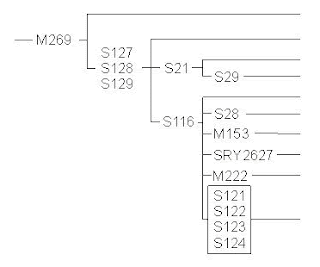
Genetree says I'm S128 which is right off the main trunk for R1b-M269. It's the Parent of one of my haplogroup guesses S21 and the Grandparent of one of the other guesses S28 as well as our buddy m222 (Northwest Irish and Scottish borders). If I had real SNP testing and it came back that we were m222 then this conversation would be moot. M222 has been pretty well proven to live in the lowlands of Scotland and Northern Ireland. That's not what these guesses for me are though. So lets look at those guesses:
S21 (my haplogroup predictor came back s21-scottish). I've read some comment that it really should be labeled s116-scottish...which would actually be a parent of S28 (my other prediction). For the sake of argument though we'll accept S21 at face value and look at it's map.

If that listing for S21 really is S116 then I may be no closer to finding some geographic locations. S116, like S28 appears to be widespread throughout the "Celtic" world and may defy mapping.
I suppose in essence that is what I'm attempting to find. Maybe not a place, but a journey. I would like to plot and connect these people on a map through time. I'd like to be able to see my Thompsons and those proto-thompsons as they move across continents and over seas.
To begin with, lets look at the maps I first looked at after getting my DNA results. This is the map Ancestry.com gave me after my DNA test.

In general these two arrows do sort of sum it up. R1b seems to spring up in central Asia and move into western Europe. The general consensus at the time of this map was that R1b people hung around in the northern Basque region of Spain and then moved north after the last Glacial Maximum to inhabit Britain and Ireland.
After I found that I was R1b I wanted to know more about it than the generic Western European I was given and I found the percentage maps for R1b concentration:

So there is R1b. Of course the more red you get the better your odds of finding people like you. Generally it follows the simple arrows of the first map. Small amounts in Eastern Europe and Central Asia moving westward to higher amounts in Northern Spain, Western Britain and France with concentration peaking in Ireland.
At this point, it seemed safe to say that the Thompsons are basically Celts. R1b seems to follow the basic pattern of Celtic tribes in europe and is busy being tied to those same timelines through archeology and dna testing of artifacts.
I'd like to narrow that map down a bit though. Europe is a big place.
In the process of trying to find relatives any way possible I entered my results at Genetree which uses the Sorenson Database. They gave me a bit more of a prediction with this subgroup: R1b1b2a*-S128
It's still well above anything definitive but it's better than nothing. Having someone guess at my results led me to go look at other predictors, as you can read in my jumbled mess of analysis.
Two possible haplogroups came to the top depending on which panels I put in the mix: S21 and S28. The reason there are always several choices is because I have a subset of the panels that most people have. Here is what Ethnosancestry and ISOGG say about those groups:
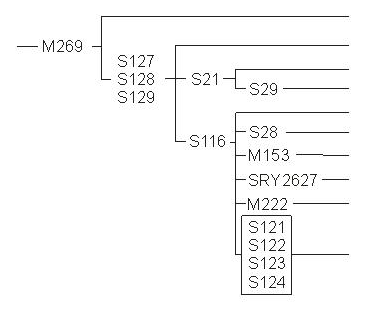
Genetree says I'm S128 which is right off the main trunk for R1b-M269. It's the Parent of one of my haplogroup guesses S21 and the Grandparent of one of the other guesses S28 as well as our buddy m222 (Northwest Irish and Scottish borders). If I had real SNP testing and it came back that we were m222 then this conversation would be moot. M222 has been pretty well proven to live in the lowlands of Scotland and Northern Ireland. That's not what these guesses for me are though. So lets look at those guesses:
S21 (my haplogroup predictor came back s21-scottish). I've read some comment that it really should be labeled s116-scottish...which would actually be a parent of S28 (my other prediction). For the sake of argument though we'll accept S21 at face value and look at it's map.

The distribution of S21 is shown in orange, along with the rest of R1b in pale yellow.
S21 is most common in the Germanic areas of the North European plain and also in England. The frequency drops dramatically south of the Alps.
S28 appears to be fairly widespread moving out from Austria. I haven't found a good map of it yet but I hope to.
If that listing for S21 really is S116 then I may be no closer to finding some geographic locations. S116, like S28 appears to be widespread throughout the "Celtic" world and may defy mapping.
Next up. Let's take a look at YHRD and see what it comes up with. Along with my own maps and maybe we can make some coherent pattern out of this mess.
Sunday, November 7, 2010
Needle in a Needle Stack
Thompson appears to be the 4th most popular name in the Northern United Kingdom. It's the 4th most popular name in Belfast Ireland after Johnston, Wilson and Campbell. I think it's the 13th most popular name in the U.S.
How can it be so hard to find people in my little branch of this tree then? It seems nearly impossible that I'm alone looking up these particular Thompsons.
Right now I'm busy waiting for some documents from the National Archives. There is no guarantee that they will find anything. A person with the Sons of Union Soldiers told me that it's most likely that Levi applied for his pension but died before he could collect it. I don't have any record of him receiving a headstone and I have no idea what his death date could be. Although I believe it's before 1880. Confusingly a Levi Thompson dies in a nearby town in 1894, but I believe that is John Levi Thompson who marries a Nancy Trueblood..different guy.
I also haven't been able to find any marriage record for Levi and Rosa/Rosanna. So I have no idea what her maiden name might be. I can't find any record of Levi before 1860 when they appear in the census in VanBuren, Madison, Indiana already married and with a few children.
Really, when I had reached Albert's father, I had hoped to find him in other family trees. Every generation I go back, mathematically, I'm just that much more likely to run into some existing family on their own path. So far no luck though.
I contacted the Methodist Church in Alexandria Indiana trying to get any possible information from them about my Thompsons but they don't have any record of them. One of my great-grandfather Ray Bishop's brothers was a Methodist when he died, but that doesn't mean the rest of the family was. I think I have some information from news articles that Bishop's sisters were Baptists as was my grandfather. I'm not sure if the Baptists keep those kind of records. I haven't heard back from the Baptist church I contacted.
I have two trees on Ancestry.com, one at myheritage.com and one at genetree. Ancestry and Genetree have my Y-dna results attached to the trees.
The waiting is the hardest part.
Saturday, October 30, 2010
Off Modal matches Map
One piece of Advice was to find off modal matches. These are people who match me at my off modal markers. Basically, they have the same mutations from modal R1b that I have at specific points, but could be different elsewhere. I made a new ysearch id that is just my off modal markers (with a few modal markers there to bulk it up and keep things on track). Then I mapped those out. Many of the names on the list are familiar to me from searching for my 9 and 16 slow marker map.
 For this map I used a variety of sources for positioning, House of Names, Surname DB, their own Pedigrees (if available) and whatever they may have listed in ysearch as an origin. I later color coded the results by how closely they match me. Blue pins match many of my off modal numbers but they have a value of 10 for DYS391 (I have 11 and it's a slow marker). Red pins have DYS391 = 11. Yellow pins with black dots have the odd 391=11, 385a=11 and 385b=11. Finally yellow pins without dots match my off modal markers further beyond 12 markers (so they have more matches overall). That is an artifact of the kind of test they had. Many people only have the 12 marker test so I would never know if they match me beyond 12 markers.
The overwhelming amount of hits in the U.K. might be proof of ancestry or it could be proof of the high rate of DNA testing done in the U.K. The specimen in Denmark is an odd man out. I haven't found many matches in Denmark at all, Ironic given their colonization of Britain. I don't know who "Danish Specimen" is from ysearch, but the Vikings did take Scottish and British slaves during their raids, sometimes numbering in the thousands. It could be indicative of that era. There is one match from Spain who is not shown.
 A closer look at the British map. The yellow without black dot markers are those that share the most off modal markers with me.
The Norton is up there in Argyllshire. On the 1881 map in people profiler Nortons are more common in East Anglia, The Midlands, Yorkshire and Ireland around Dublin and the Irish Midlands. Not Argyllshire or Kent as House of Names gives for the homeland of those people.
The Burnett placed in Berwickshire by HON (near Edinburgh). In 1881 there are more Burnetts in Aberdeen and Harrogate (near York).
Thompson placed in Cumbria by HON, in 1881 is represented well in Cumbria but most popular in Newcastle Upon Tyne in Tyne and Wear near Northumberland. The most popular Thompson Postal city is Belford north up the coast from Newcastle Upon Tyne near the Scottish border. Oddly enough, google searches for Belford turn up Belford Cumbria which makes it hard to determine if Belford is part of some greater "Cumbria" unrelated to the County Cumbria that has Carlisle in it.
Bell placed in Cumbria by HON and on this map is popular in Cumbria, Dumfriesshire and Northumberland on or over the Scottish border. Carlisle is the top area. Ravenglass (in Cumbria) is the top postal town. Bell is also the only other well known Borders area family name in this little Yellow pin without dot list besides Thompson. There are plenty of borders families represented in other colored pins but Bell has the most markers to match mine.
Keyes placed in Yorkshire by HON. In 1881 the only place they are common in Britain is tiny Southend by Sea which is between Kent and East Anglia. The name is actually most common in Ireland in Offaly and Laois.
Knowlton (always comes up high in any sort of Match list because we have the most markers in Common) is placed in Kent by HON and in Kent or Dorset by Surnamedb. It's most popular in Maine, New Hampshire and New Brunswick now. One Knowlton Family claims Kent in their pedigree. In 1881 Britain it's most popular in Southampton a busy port city in the south central part of Britain.
Also in this group, but not on the British map, is the "Danish Specimen" mentioned above. I'm not sure what the testing rate is in Denmark. I've been to the Danish y dna project and there are not many people there. It may be that there are huge sections of the population that share this DNA pattern but because of lack of testing we're not seeing it. Or, like I said above, it may be that this person represents a slave who passed on their DNA in their life in Denmark.
Obviously, given the small amount of total matches it's safe to say that these people or family lines are probably not representative of their total surname populations. This entire map contains 2 Thompsons out of probably hundreds or thousands of records and we don't even match each other that well.
Still these samples are pretty scattered. Like I said, Bell and Thompson are the only names that appear to be from the same region and even with that, we don't appear to be representative of our surnames..in fact we seem to be quite odd. I think in all my maps an overall pattern is evident. If we're to follow the general pattern of movement from east to west in R1b, some roughly Germano-Celtic people moved into England and from there Ireland. People who are yellow pins (dot or no) seem to be generally in northern and western Germany and then sort of peppered around Britain.
In this map my showing for Ireland is pretty small with most matches in Ulster. Since Ulster historically has been populated by Borders area Scots and English Reiver families (along with some contingent from Wales I've heard) it seems again really likely that we're a border family. The odds are still in favor of the Thompsons having moved to North Ireland during the plantation and from there to America.
Subscribe to:
Posts (Atom)